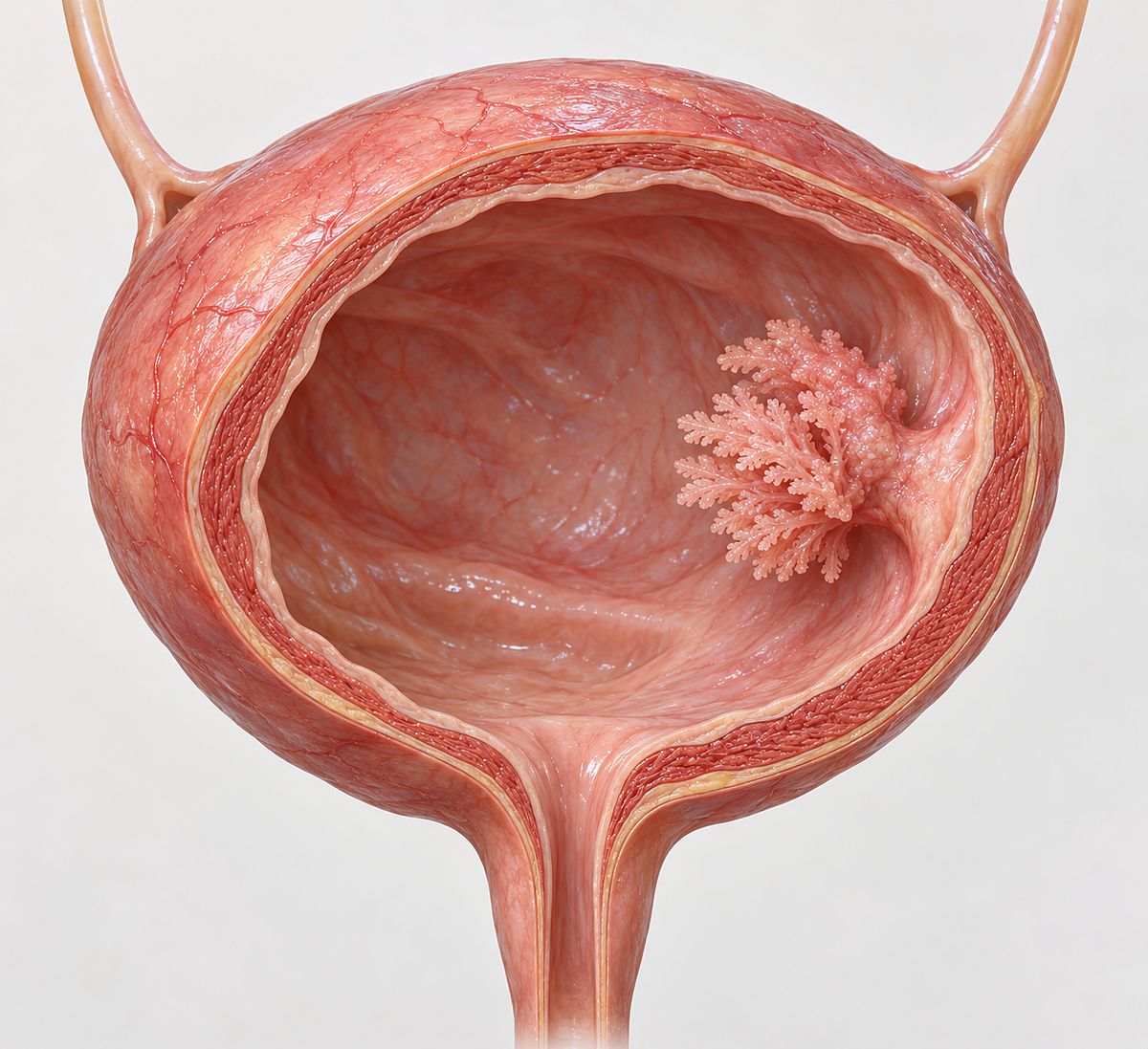
Most Bladder Cancers are found while they are still confined to the inner lining of the bladder. They are called non-muscle-invasive tumours and are removed through the urethra by TURBT (transurethral resection of bladder tumour), so no cut is needed. The main problem with these tumours is not spread but recurrence: without further treatment, many come back in the bladder lining.
BCG (Bacillus Calmette-Guérin) is the most effective treatment for reducing this risk in higher-risk tumours. It is given directly into the bladder through a thin catheter, so it acts on the bladder lining and very little reaches the rest of the body. This guide explains who needs BCG, what each session involves and how to manage it at home.
What BCG is and how it works
BCG is a weakened form of the bacterium originally used as the tuberculosis vaccine. Placed in the bladder, it stimulates the body's immune system to attack cancer cells in the bladder lining. It is not chemotherapy, and it is not given to vaccinate you.
Given correctly, BCG lowers the chance of the tumour coming back and, importantly, the chance of it progressing into the bladder muscle, which would usually mean removal of the bladder.
Who needs BCG?
The decision depends on the pathology report after TURBT: the tumour's grade, its stage, its size and number, and whether carcinoma in situ (CIS) is present.
| Risk group | Typical features | Usual treatment after TURBT |
|---|---|---|
| Low | Single, small, low-grade Ta tumour | A single dose of chemotherapy into the bladder, then check cystoscopies |
| Intermediate | Low-grade but multiple, larger or recurring tumours | A course of chemotherapy instillations, or BCG for one year |
| High | High-grade tumour, stage T1, or CIS | BCG for up to three years |
For T1 or high-grade tumours, a second TURBT is usually done 2 to 6 weeks after the first, before BCG starts. It confirms that no tumour was left behind and that the muscle is not involved.
Related: Intravesical chemotherapy · Bladder Cancer stages · Recurrence and progression risk (EORTC)
The schedule: induction and maintenance
- Induction: BCG usually starts 2 to 4 weeks after TURBT, once the bladder has healed, and is given once a week for six weeks.
- First check: a cystoscopy, often with a urine cytology test, about three months after starting.
- Maintenance: if the bladder is clear, BCG continues as short courses of one dose a week for three weeks, usually at 3, 6 and 12 months, and then every six months. High-risk tumours are treated for up to three years and intermediate-risk tumours for one year.
Maintenance matters. The six-week course alone gives less protection than induction followed by maintenance. If side effects make the full schedule difficult, the dose or the number of instillations can often be adjusted rather than stopping altogether.
What happens at each session
Each session is done in the OPD or day-care and takes about 15 minutes, followed by a wait at home or in the hospital.
- Before you come: limit fluids for about four hours beforehand, so the urine does not dilute the BCG. Empty your bladder just before the instillation.
- A urine test may be done to check for infection.
- A thin, lubricated catheter is passed into the bladder, the BCG solution is run in, and the catheter is removed straight away.
- Hold the urine for up to two hours, then pass urine sitting down.
- After that, drink plenty of fluids for the rest of the day to flush the bladder.
The instillation is postponed if there is a urine infection, visible blood in the urine, or if passing the catheter was difficult or caused bleeding. These increase the chance of BCG entering the bloodstream.
Precautions at home
For about six hours after each instillation, your urine contains live BCG.
- Men and women should sit down to pass urine, to avoid splashing.
- Flush the toilet twice, with the lid down.
- Wash your hands and genital area with soap and water after passing urine.
- Use a condom for sex for a week after each instillation, or avoid sex during this time.
- Avoid pregnancy during treatment.
BCG in the bladder does not give tuberculosis to your family, and you do not need to be kept apart from them.
Side effects
Most people tolerate BCG well, though side effects often increase as the course goes on.
Common and expected (usually settle within 48 hours):
- Burning when passing urine, and needing to go often and urgently
- A little blood in the urine
- Tiredness, mild fever (below 38.5 °C) and flu-like aches for a day or two
Plenty of fluids and simple painkillers such as paracetamol help. Tell the team at your next visit, because these effects guide the plan for the next dose.
Contact the hospital urgently if you have:
- Fever above 38.5 °C, or any fever lasting more than 48 hours
- Shivering, or feeling very unwell
- Painful, swollen joints, a painful or red eye, or a painful swollen testicle
- A cough or breathlessness that is new
- Inability to pass urine, or heavy bleeding with clots
These can be signs of BCG infection outside the bladder. They are rare, but need prompt treatment with anti-tuberculosis medicines.
Who should not receive BCG?
BCG may not be suitable if you:
- have a weakened immune system, for example from steroids, other immune-suppressing medicines, an organ transplant or HIV with a low CD4 count
- currently have active tuberculosis
- are pregnant or breastfeeding
Tell your doctor about all your medicines and illnesses before starting.
When BCG is not available
India and many other countries have had periodic shortages of BCG. If BCG cannot be obtained, effective alternatives include a reduced-dose BCG schedule or courses of chemotherapy into the bladder, such as gemcitabine, sometimes combined with docetaxel. Your treatment can be planned so that protection is not lost while you wait.
If BCG does not work
If a high-grade tumour or CIS returns despite an adequate course of BCG, the disease is called BCG-unresponsive. These tumours have a higher risk of invading the muscle, so robotic radical cystectomy (removal of the bladder) is usually recommended. For patients who are not fit for or do not want surgery, newer bladder-sparing treatments are being used.
Related: Bladder Cancer treatment options · Urinary diversion after cystectomy · Robotic Surgery
Follow-up after BCG
Even after successful treatment, non-muscle-invasive Bladder Cancer needs regular check cystoscopies: usually every three months for the first two years, then less often. The kidneys and ureters are imaged periodically, because the same type of cancer can occasionally arise there. Stopping smoking is one of the most effective things you can do to lower the chance of the cancer returning.
Related: Blood in urine: when it is a sign of cancer · Follow-up for Bladder Cancer
Consultation
Dr. Anshuman Singh, Uro-Oncologist & Robotic Surgeon, treats Bladder Cancer with TURBT, BCG and Robotic Surgery. He sees patients at the Uro-Oncology OPD, Chandan Hospital (10 AM – 4 PM) and at Uro-Onco Connect, Gomti Nagar (6 – 9 PM), Monday to Friday, and by teleconsultation. TURBT pathology reports and cystoscopy findings can be shared in advance. Book a consultation.
Frequently asked questions
Is BCG treatment for Bladder Cancer painful?
The instillation itself takes a few minutes and feels similar to having a catheter passed. Burning and frequent urination for a day or two afterwards are common and usually settle with fluids and simple painkillers.
How long does BCG treatment last?
Induction is one instillation a week for six weeks. For high-risk tumours, maintenance courses of three weekly instillations follow, usually at 3, 6 and 12 months and then every six months, for up to three years.
How long should I hold the urine after BCG?
Up to two hours, then pass urine sitting down. Afterwards, drink plenty of fluids for the rest of the day.
Can my family catch tuberculosis from me during BCG treatment?
No. BCG in the bladder does not pass tuberculosis to family members. For about six hours after each dose, sit to pass urine, flush twice and wash your hands, and use a condom for a week after each instillation.
How successful is BCG for Bladder Cancer?
BCG with maintenance is the most effective bladder treatment for high-risk non-muscle-invasive tumours. It substantially reduces the chance of the tumour returning or invading the muscle, and most patients keep their bladder.
What happens if BCG fails?
If high-grade cancer returns despite adequate BCG, removal of the bladder (radical cystectomy, often robotic) is usually recommended. Newer bladder-sparing drugs may be options for patients who are not fit for surgery.
This article is for general education and does not replace a personal medical consultation.