Patients advised to have cancer surgery often hear three different words: open, laparoscopic and robotic. They describe how the surgeon reaches the organ, not what is removed. The cancer operation itself, such as removing the prostate or the kidney tumour, is the same in principle.
This article explains the three approaches and how to think about the choice.
The three approaches
| Open surgery | Laparoscopic ("keyhole") | Robotic Surgery | |
|---|---|---|---|
| Access | One larger incision | Several small cuts, long straight instruments | Several small cuts, robotic arms controlled by the surgeon |
| Surgeon's view | Direct vision | 2D or 3D camera on a monitor | Magnified 3D high-definition view |
| Instruments | Hands and standard instruments | Rigid, straight | Wristed instruments with a wide range of movement |
| Who operates | The surgeon | The surgeon | The surgeon; the robot does not act on its own |
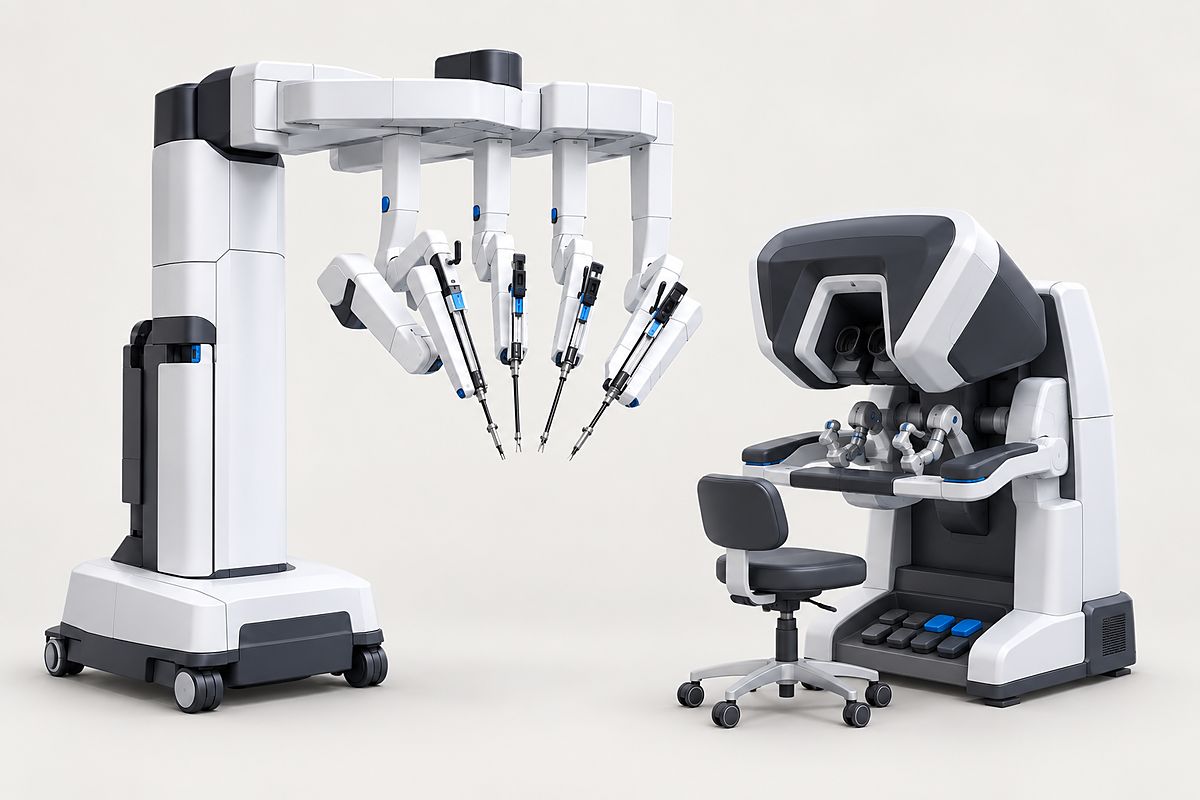
In Robotic Surgery, the surgeon sits at a console next to the patient and controls every movement. The robot is a tool that translates the surgeon's hand movements into precise movements of tiny instruments.
Related: How Robotic Surgery works
What are the potential benefits of minimally invasive surgery?
Compared with open surgery, laparoscopic and robotic approaches commonly offer:
- Smaller wounds and less pain
- Less blood loss
- Shorter hospital stay and faster return to routine activity
- Less scarring
Robotic Surgery adds a magnified three-dimensional view and wristed instruments, which are especially helpful in tight spaces such as the pelvis, and for operations that need careful dissection and stitching, such as nerve-sparing prostatectomy, partial nephrectomy and reconstruction after cystectomy.
Related: Benefits of Robotic Surgery
What does the evidence show?
Randomised trials and large studies comparing robotic and open surgery for prostate and bladder cancers have shown that, in well-selected patients and experienced hands, cancer control is similar. Early functional outcomes (such as continence and erections) have also been broadly comparable in the trials, with the clearest advantages of minimally invasive surgery being less blood loss and a shorter stay.
This is worth stating plainly: the robot does not cure cancer better by itself. What drives results is the right operation for the right patient, done by an experienced surgeon, followed by good postoperative care. Robotic Surgery is a better way to carry out that operation for many patients, not a substitute for judgement.
Is open surgery still needed?
Yes. Open surgery remains the right choice in some situations, for example:
- Very large or complex tumours, or tumours involving major blood vessels such as the vena cava
- Extensive previous surgery or scarring in the abdomen
- Certain operations that a surgeon is more experienced with in the open approach
- When it is the safest way to achieve complete removal of the cancer
A responsible surgeon will recommend open surgery when it gives the best chance of safe, complete cancer removal, or will convert from robotic to open during an operation if safety requires it. That is good judgement, not a failure.
Which operations are commonly done robotically?
- Radical prostatectomy for Prostate Cancer
- Partial and radical nephrectomy for Kidney Cancer
- Radical cystectomy with urinary diversion for Bladder Cancer
- Retroperitoneal lymph node dissection in selected testicular cancers
- Inguinal lymph node dissection for penile cancer in selected patients
Related: Recovery after robotic prostatectomy · Partial vs radical nephrectomy · Robotic cystectomy and bladder preservation
Questions to ask your surgeon
- Which approach do you recommend for my cancer, and why?
- How many of these operations do you perform each year?
- What are the risks specific to my case, and how often does conversion to open surgery happen?
- What recovery should I expect, and when can I return to work?
- What is the estimated cost, and what is covered by my insurance?
Costs vary by hospital, room category and insurance. Robotic procedures often cost more than open surgery; a shorter stay can partly offset this. Ask for a written estimate before deciding.
Guidelines
This article is consistent with the EAU guidelines for Prostate, Bladder and Renal Cell Carcinoma, which accept minimally invasive and open approaches as options when performed by experienced surgeons.
Consultation
Dr. Anshuman Singh, Uro-Oncologist & Robotic Surgeon, performs robotic uro-oncological surgery in Lucknow and sees patients at the Uro-Oncology OPD, Chandan Hospital (10 AM – 4 PM) and at Uro-Onco Connect, Gomti Nagar (6 – 9 PM), Monday to Friday, and by teleconsultation. Reports and scans can be shared in advance. Book a consultation.
Frequently asked questions
Does the robot operate by itself?
No. The surgeon controls every movement from a console. The robot has no independent function.
Is Robotic Surgery better than open surgery for cancer?
Cancer control is similar in well-selected patients when done by experienced surgeons. Robotic Surgery usually offers less blood loss, smaller wounds and a faster recovery. The better approach is the one that is safest and most effective for your cancer.
What is the difference between laparoscopic and robotic surgery?
Both use small cuts. Robotic Surgery gives the surgeon a magnified 3D view and wristed instruments, which make fine dissection and suturing easier in confined spaces.
Can my surgery be converted from robotic to open?
Occasionally, if bleeding, scarring or unexpected findings make it safer. Consent for this is taken beforehand, and it is done to protect you.
Is Robotic Surgery suitable for everyone?
Not always. Very large tumours, extensive previous surgery or certain medical conditions may make open surgery safer. Your surgeon will advise you after reviewing your scans.
Treatment in Lucknow
Dr. Anshuman Singh is a Uro-Oncologist and Robotic Surgeon in Lucknow. Read about Urological Cancers treatment in Lucknow and Robotic Surgery for Urological Cancers, or book a consultation in person or by teleconsultation.
This article is for general education and does not replace a personal medical consultation.