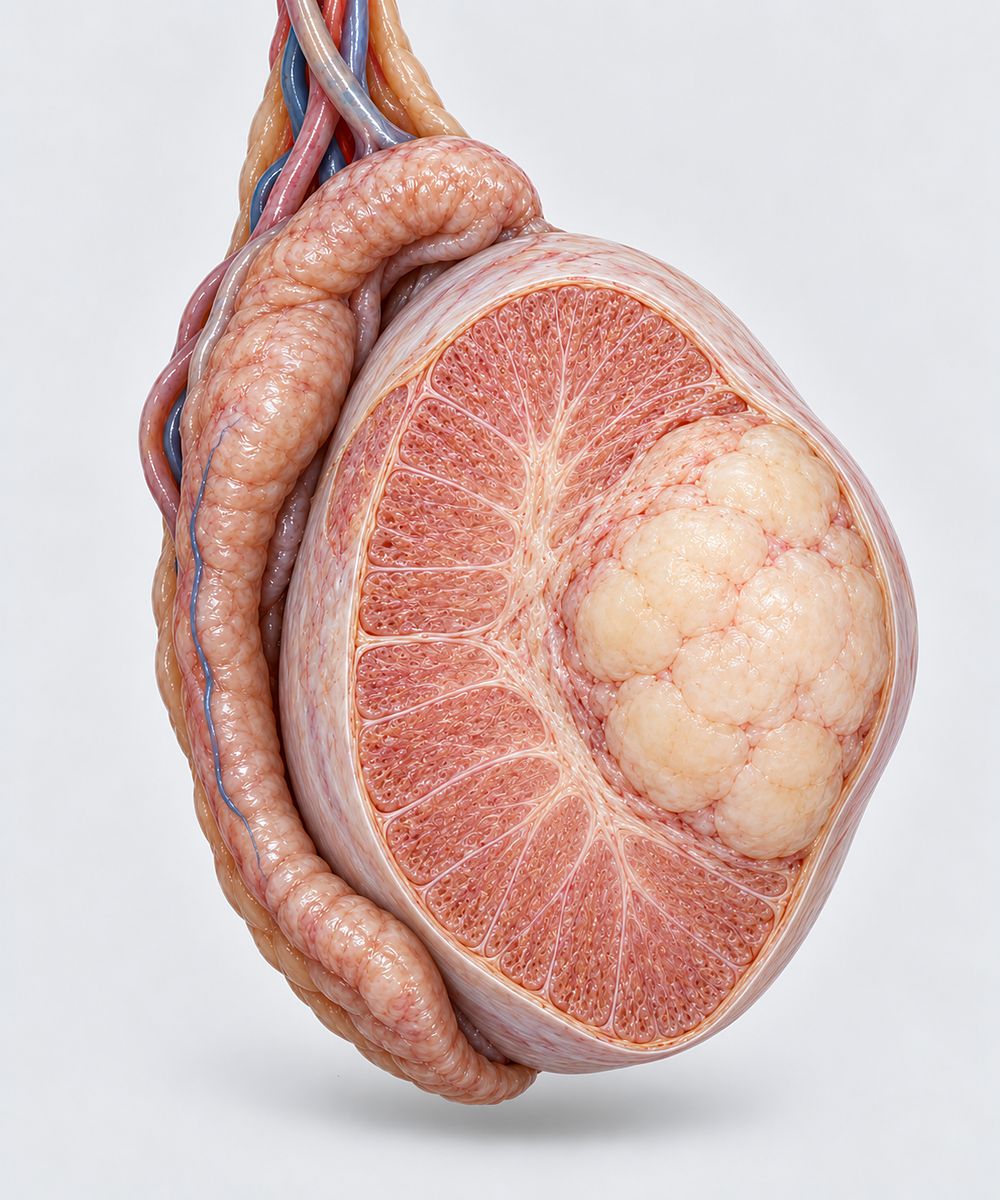
Finding a lump in the scrotum is alarming, and many young men delay seeing a doctor out of embarrassment or fear. The most important message is simple: a new lump in the testicle should be checked promptly. Many lumps are harmless, but Testicular Cancer is most common in young men and is highly curable when found early.
This article explains the common causes of a scrotal lump, the features that point to cancer, the tests that are done and how to examine yourself.
Common causes of a scrotal lump
| Cause | What it feels like |
|---|---|
| Epididymal cyst or spermatocele | A soft, smooth lump above or behind the testicle, separate from it |
| Hydrocele | Fluid around the testicle; smooth swelling that may be translucent |
| Varicocele | "Bag of worms" feeling, usually on the left side, more obvious when standing |
| Epididymo-orchitis | Painful, tender, swollen testicle, sometimes with fever or burning urine |
| Inguinal hernia | Swelling that extends up to the groin and may change with coughing |
| Testicular tumour | A firm, usually painless lump or hardness within the testicle itself |
You cannot reliably tell these apart by feel alone. An ultrasound does that.
Features that suggest Testicular Cancer
- A hard lump or area of hardness inside the testicle, often painless
- The testicle feels heavier or larger than before
- A dull ache or heaviness in the lower abdomen, groin or scrotum
- Sometimes breast tenderness or enlargement, from hormones made by some tumours
- Back pain or breathlessness in advanced disease, which is uncommon at first presentation
Testicular Cancer is most common between the ages of about 15 and 40. It is more likely in men with a history of an undescended testicle, a previous testicular cancer or a family history, though many men with it have no such history.
Related: Testicular Cancer symptoms
When is it an emergency?
Sudden, severe testicular pain with nausea or vomiting may be testicular torsion: the testicle twists and loses its blood supply. This needs surgery within hours to save the testicle. Do not wait to see if it settles. Go to an emergency department immediately.
What happens at the consultation?
- History and examination of both testicles, the groin and the abdomen.
- Scrotal ultrasound, the key test. It shows whether a lump is inside the testicle or outside it, and whether it looks solid or cystic. It is painless and quick.
- Blood tumour markers: AFP, beta-hCG and LDH. These are raised in many testicular tumours and help in diagnosis and follow-up. Normal levels do not exclude cancer.
- Sperm banking is offered before any treatment to men who may wish to father children in the future.
If the ultrasound shows a lump that looks like a tumour, scans of the chest, abdomen and pelvis (usually CT) are done to look for spread.
Related: How Testicular Cancer is diagnosed
How is a testicular tumour treated?
Treatment starts with removing the testicle through a cut in the groin (inguinal radical orchidectomy). Surgeons avoid cutting the scrotum or taking a needle biopsy of a suspected tumour, because that can change the route by which cancer might spread.
After the pathology report and scans, the next step depends on the tumour type (seminoma or non-seminoma) and its stage. Options include:
- Surveillance with scans and markers
- A short course of chemotherapy
- Radiotherapy for selected seminomas
- Retroperitoneal lymph node dissection for selected non-seminoma patients, which may be done robotically in suitable cases
Even when Testicular Cancer has spread, it is often curable with chemotherapy, which is one reason early review and specialist treatment matter. A prosthesis can be placed if you wish. Most men can still father children with one testicle, and fertility discussion is part of the plan.
Related: Testicular Cancer treatment · Fertility and Testicular Cancer
How to check yourself
Do this once a month, ideally after a warm bath or shower when the scrotal skin is relaxed.
- Stand in front of a mirror and look for swelling.
- Examine each testicle on its own: hold it between thumb and fingers and roll it gently.
- Feel for any hard lump, change in size or shape, or area of hardness. It is normal for one testicle to be slightly larger and for the epididymis (a soft cord at the back) to be felt.
- Note any pain, heaviness or change since the last check.
If you find something new that lasts more than a week or two, or any hard lump, see a doctor without waiting.
Guidelines
This article is consistent with the EAU Testicular Cancer guidelines and the NCCN Testicular Cancer guidelines.
Consultation
Dr. Anshuman Singh, Uro-Oncologist & Robotic Surgeon, sees patients in Lucknow at the Uro-Oncology OPD, Chandan Hospital (10 AM – 4 PM) and at Uro-Onco Connect, Gomti Nagar (6 – 9 PM), Monday to Friday, and by teleconsultation. Ultrasound reports and blood tests can be shared in advance. Book a consultation.
Frequently asked questions
Is every testicular lump cancer?
No. Many are cysts, fluid collections, varicoceles or infections. But a hard lump inside the testicle needs an ultrasound promptly, because it can be a tumour.
Is a painless testicular lump more worrying than a painful one?
Testicular tumours are typically painless, so a painless hard lump is a reason to seek review soon. Pain usually points to infection or torsion, which also needs prompt attention.
Can a testicular lump go away on its own?
Some swellings from infection settle with treatment. A lump that persists for more than a week or two should be examined and scanned, not watched.
Will I lose fertility if I have a testicle removed?
Most men can father children with one healthy testicle. Sperm banking before treatment is offered when future fertility matters to you.
Is Testicular Cancer curable?
It is among the most curable cancers, including many cases that have spread, when treated by a specialist team. Early diagnosis improves outcomes and makes treatment simpler.
Treatment in Lucknow
Dr. Anshuman Singh is a Uro-Oncologist and Robotic Surgeon in Lucknow. Read about Testicular Cancer treatment in Lucknow and Robotic Surgery for Urological Cancers, or book a consultation in person or by teleconsultation.
This article is for general education and does not replace a personal medical consultation.